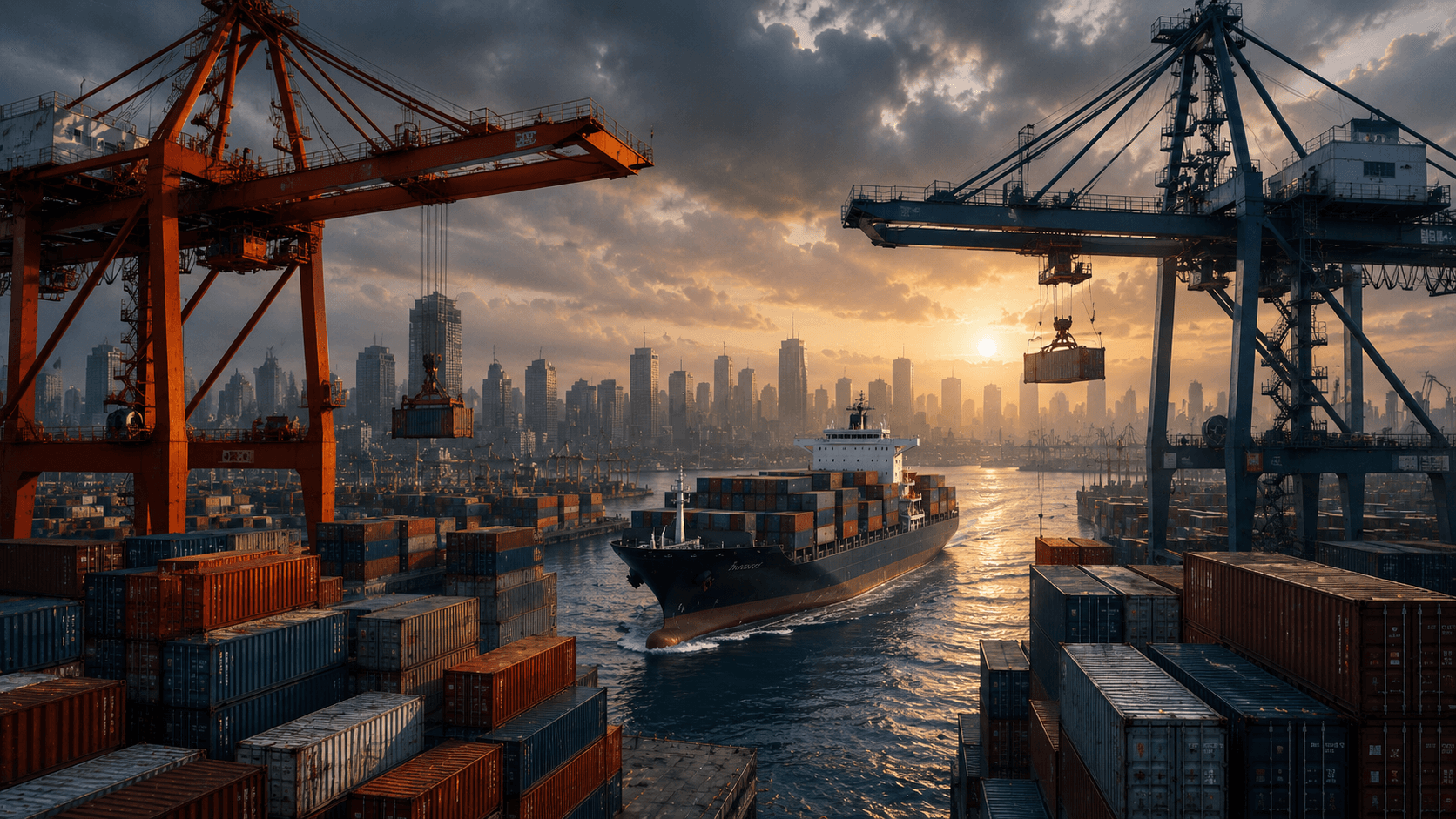
The New Global Trade War Is Taking Shape
Why Countries Are Putting Economic Security Before Globalization
June 2026
For decades, globalization appeared unstoppable.
Goods moved across borders with increasing ease.
Manufacturing spread across continents.
Supply chains became highly efficient.
Consumers benefited from lower prices and greater choice.
Businesses gained access to global markets.
Investors embraced a world where economic integration seemed inevitable.
Today, that trend is beginning to reverse.
Around the world, governments are increasingly prioritizing economic security, domestic production, and strategic independence.
The result is the emergence of what many economists describe as a new global trade war.
Unlike previous trade disputes, this one extends far beyond tariffs.
It involves technology, energy, manufacturing, critical minerals, and national security.
The Era of Free Trade Is Being Questioned
For years, free trade was viewed as a driver of economic growth.
By allowing countries to specialize in what they produced most efficiently, global trade helped reduce costs and improve productivity.
However, recent events have exposed vulnerabilities in that system.
Pandemic disruptions revealed supply chain weaknesses.
Geopolitical tensions increased concerns about economic dependence.
Conflicts highlighted the risks of relying heavily on foreign suppliers for critical goods.
Governments began asking a new question:
What happens if vital imports suddenly become unavailable?
That concern is now influencing economic policy around the world.
Tariffs Are Making a Comeback
One of the clearest signs of changing trade priorities is the return of tariffs.
Countries are increasingly imposing duties on imported goods to protect domestic industries.
Supporters argue that tariffs help strengthen local manufacturing, protect jobs, and reduce strategic vulnerabilities.
Critics warn that tariffs increase costs for consumers and businesses.
Regardless of the debate, tariffs are becoming a more common feature of global trade policy.
What was once considered a temporary measure is increasingly viewed as a long-term strategy.
Technology Has Become a Battleground
Modern trade disputes are no longer limited to traditional industries.
Technology has become one of the most important fronts in the new trade war.
Governments are competing for leadership in:
- Semiconductors
- Artificial intelligence
- Telecommunications
- Advanced manufacturing
- Quantum computing
Export controls and investment restrictions are becoming more common.
Countries increasingly view technological leadership as a matter of economic and national security.
As a result, technology policy and trade policy are becoming deeply intertwined.
The Supply Chain Transformation
Businesses are adapting to this new reality.
Rather than relying on a single country for manufacturing, many companies are diversifying operations across multiple regions.
This strategy aims to improve resilience against future disruptions.
Terms such as "friend-shoring" and "near-shoring" have become increasingly common.
Manufacturers are prioritizing reliability alongside efficiency.
While these changes may strengthen supply chains, they can also increase costs.
The era of maximizing efficiency at all costs appears to be fading.
Winners and Losers
Trade wars create both opportunities and challenges.
Countries that attract new manufacturing investment may benefit from job creation and economic growth.
Industries receiving government support may expand rapidly.
At the same time, exporters can face new barriers.
Consumers may experience higher prices.
Businesses may encounter greater uncertainty when planning investments.
The impact varies across sectors, regions, and industries.
This complexity makes trade policy one of the most important economic issues of the decade.
Why Investors Are Paying Attention
Financial markets closely monitor trade developments because they influence corporate profits, economic growth, and inflation.
A new tariff can affect an entire industry overnight.
Supply chain shifts can create winners and losers.
Commodity demand can change significantly.
Investors increasingly recognize that trade policy is no longer a niche political issue.
It has become a major market driver.
Understanding trade relationships is becoming an essential part of investment analysis.
The Bigger Picture
The new trade war is not simply about imports and exports.
It reflects a broader shift in how governments view economic strategy.
Efficiency is no longer the only goal.
Resilience matters.
Security matters.
Strategic independence matters.
This does not mean globalization is ending.
International trade will remain a fundamental part of the global economy.
However, the rules of globalization are changing.
The coming decade is likely to feature more competition, more industrial policy, and greater economic fragmentation than the world experienced during the peak of globalization.
For businesses, investors, and governments, adapting to that reality may become one of the defining challenges of the modern economy.
Leave A Reply
Your email address will not be published.*