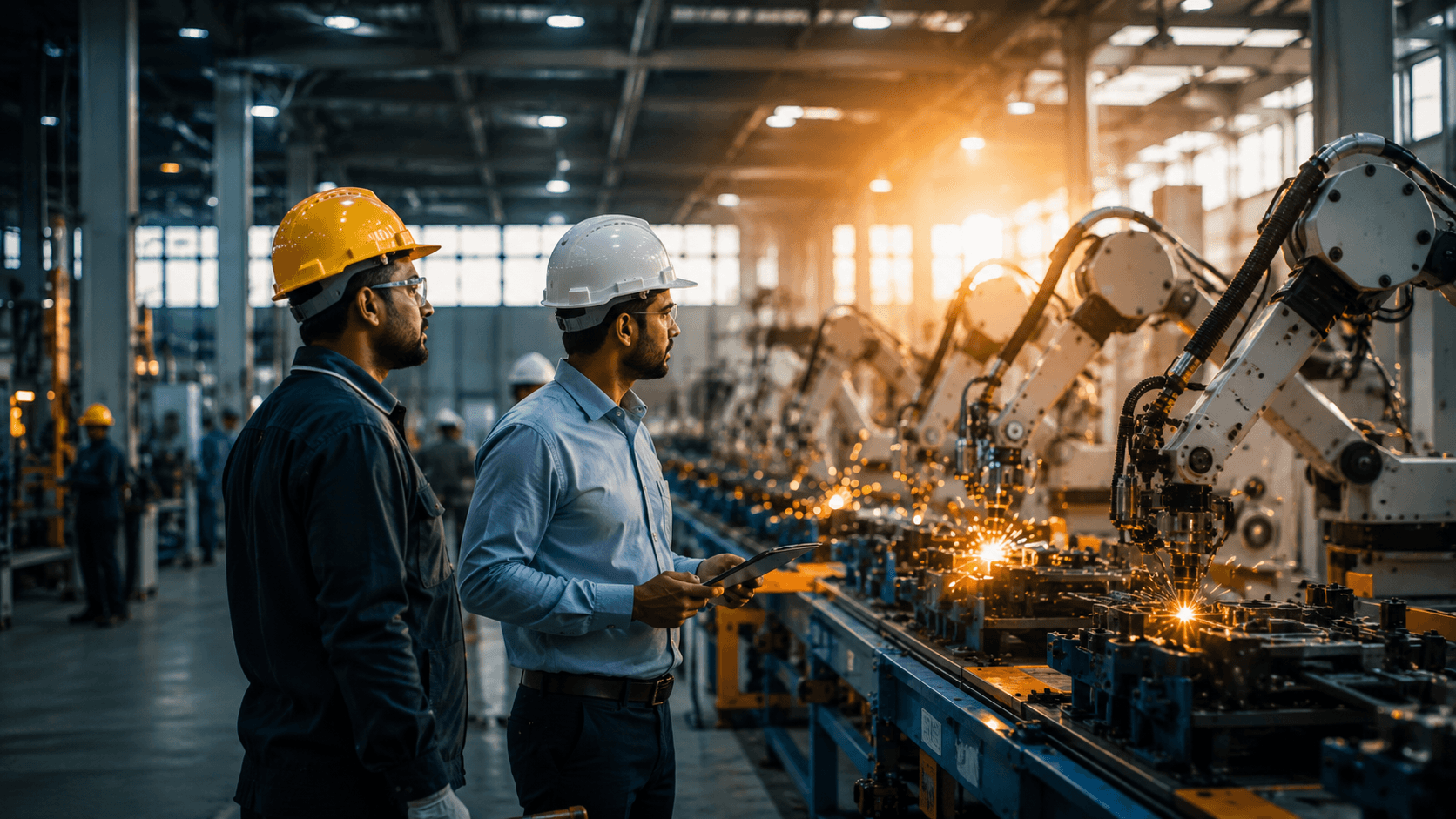
Why Industrial AI Matters
The global conversation around artificial intelligence often focuses on chatbots, virtual assistants, and consumer technologies. Yet some of the most significant economic gains from AI may emerge in factories, warehouses, power plants, transportation networks, and industrial operations.
This shift is creating what many analysts describe as the Industrial AI Revolution. Unlike traditional automation, Industrial AI enables machines and systems to learn from data, predict outcomes, optimize operations, and improve decision-making in real time.
For India, this transformation presents more than a technological opportunity. It represents a chance to strengthen manufacturing competitiveness, increase productivity, attract investment, and accelerate economic growth.
Background and Context
Industrial revolutions have historically reshaped global economic leadership. Nations that successfully adopted steam power, electricity, mass production, and digital technologies often gained long-term competitive advantages.
Today, AI is emerging as the next major industrial technology. Manufacturers worldwide are using AI to improve quality control, reduce equipment failures, optimize supply chains, and increase operational efficiency.
India enters this period with several advantages. The country possesses one of the world's largest technology talent pools, a rapidly expanding digital economy, and ambitious manufacturing goals. Government initiatives promoting digital infrastructure, innovation, and industrial development have also strengthened the foundation for future growth.
At the same time, global companies are increasingly seeking alternatives to concentrated manufacturing locations, creating opportunities for emerging industrial hubs.
Main Drivers Behind the Opportunity
One of India's strongest advantages is talent. The country produces large numbers of engineers, software developers, data specialists, and technology professionals each year. This workforce can help bridge the gap between AI innovation and industrial deployment.
Manufacturing expansion is another key driver. As companies diversify supply chains and invest in new production facilities, AI-enabled factories can help improve productivity and global competitiveness.
The rapid growth of digital infrastructure is equally important. Expanding internet connectivity, cloud computing adoption, digital payment systems, and data platforms provide the technological foundation required for Industrial AI applications.
India's startup ecosystem also plays a significant role. Technology startups are increasingly developing AI solutions for manufacturing, logistics, agriculture, healthcare, and energy sectors. These innovations can help accelerate adoption across industries.
Furthermore, the growing availability of industrial data is creating new opportunities for predictive maintenance, process optimization, quality monitoring, and operational intelligence.
Impact on Businesses, Markets, and Society
For businesses, Industrial AI offers the potential to improve efficiency while reducing costs. Predictive systems can identify equipment failures before they occur, minimizing downtime and improving productivity.
Supply chains can become more responsive through AI-driven forecasting and logistics management. Manufacturers can optimize production schedules, inventory levels, and resource allocation using real-time insights.
Investors are paying close attention to these developments. Countries and companies that successfully integrate AI into industrial operations may attract greater investment due to expectations of higher productivity and stronger long-term competitiveness.
For workers, the impact is more complex. While some routine tasks may become automated, demand for higher-skilled roles is likely to increase. Engineers, AI specialists, technicians, data analysts, and digital operations managers could become increasingly important within modern industrial organizations.
Governments also have a stake in this transformation. Industrial AI can contribute to economic growth, export competitiveness, infrastructure modernization, and job creation in emerging technology sectors.
Future Outlook
India's ability to lead the Industrial AI Revolution will depend on execution rather than potential alone. Investments in education, digital infrastructure, research, and industrial modernization will remain critical.
The next decade may see AI integrated across manufacturing plants, logistics hubs, transportation systems, energy networks, and agricultural operations. Companies that adopt AI effectively could gain significant productivity advantages over competitors.
Collaboration will also be essential. Partnerships between technology companies, manufacturers, universities, startups, and policymakers can help accelerate innovation and workforce development.
At the same time, organizations must address challenges related to cybersecurity, data governance, workforce training, and responsible AI deployment. Long-term success will require balancing technological advancement with operational reliability and trust.
Bigger Picture
The Industrial AI Revolution is not simply about automation. It represents a broader transformation in how economies produce goods, manage resources, and create value.
For India, the opportunity extends beyond becoming a consumer of advanced technologies. It is a chance to become a creator, developer, and global exporter of Industrial AI solutions.
If the country successfully combines its talent base, manufacturing ambitions, entrepreneurial ecosystem, and digital infrastructure, it could play a leading role in shaping the next era of industrial development. In a world increasingly driven by intelligent systems, that position could become one of India's most important economic advantages.
Leave A Reply
Your email address will not be published.*