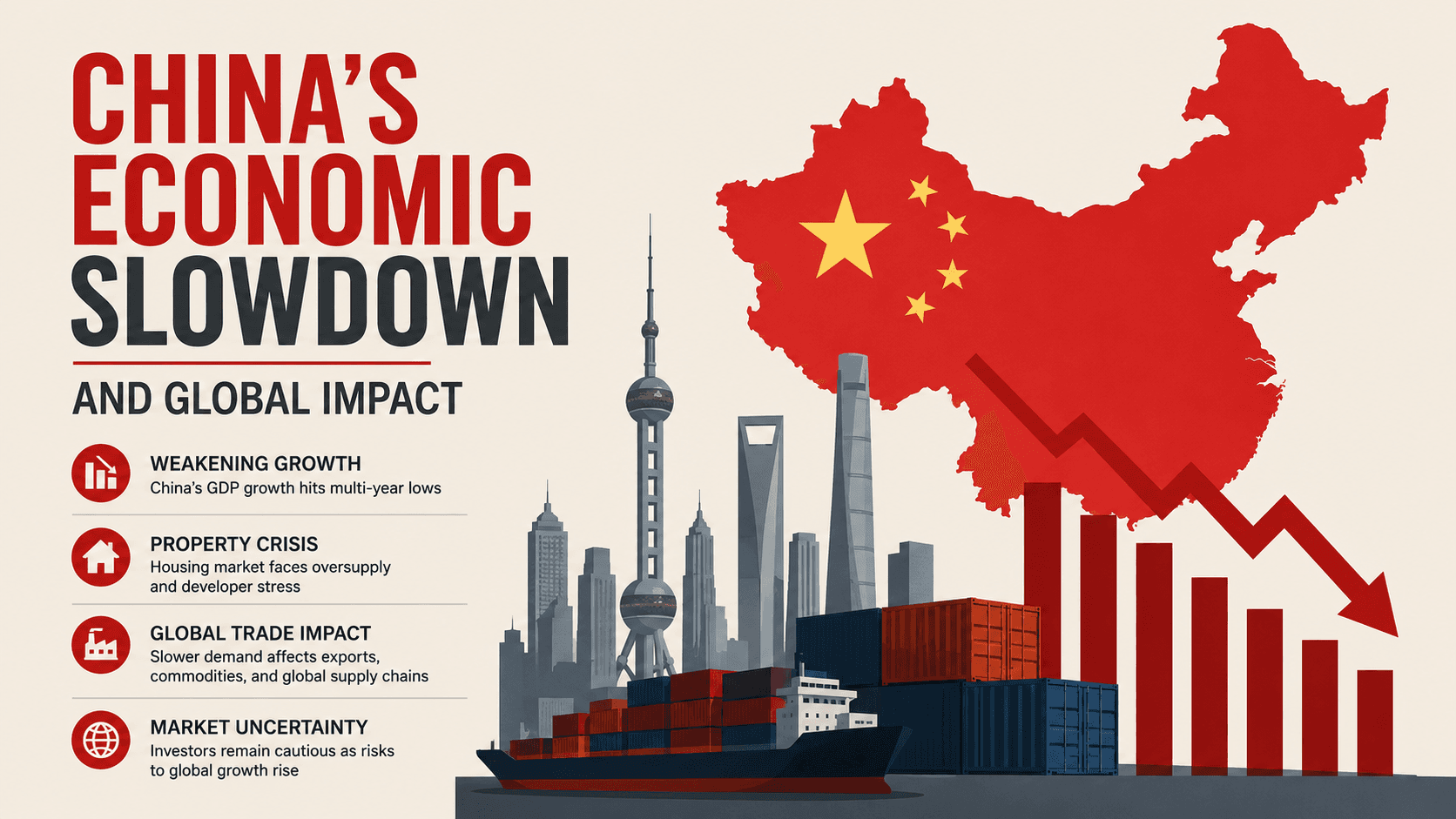
China's Economic Slowdown and Global Impact
Why the World's Second-Largest Economy Matters to Everyone
June 2026
When the United States sneezes, the global economy catches a cold.
For decades, that phrase described the influence of the world's largest economy.
Today, however, many economists believe a similar statement applies to China.
As the world's second-largest economy and one of the most important manufacturing hubs on Earth, China's economic health affects businesses, governments, investors, and consumers across the globe.
That is why recent signs of slowing growth have attracted enormous international attention.
The concern is not simply about China.
It is about the ripple effects that a weaker Chinese economy can create throughout the global financial system.
The End of an Extraordinary Growth Era
For more than four decades, China experienced one of the most remarkable economic expansions in modern history.
Rapid industrialization, infrastructure development, urbanization, and export growth transformed the country into a global economic powerhouse.
Millions were lifted out of poverty.
Cities expanded at an unprecedented pace.
Manufacturing output surged.
Foreign investment flowed into the country.
But economies rarely grow at extraordinary rates forever.
As China's economy matures, growth has naturally begun to slow.
The challenge facing policymakers is ensuring that slower growth remains manageable rather than becoming a long-term economic drag.
The Property Market Problem
One of the biggest challenges facing China is its property sector.
For years, real estate played a central role in economic growth.
Developers borrowed heavily.
Construction boomed.
Property values rose steadily.
Many households viewed housing as a primary investment vehicle.
However, declining demand, financial stress among developers, and excess housing supply have created significant pressure on the sector.
Because real estate contributes substantially to economic activity, weakness in housing can affect everything from construction jobs to consumer confidence.
The property market remains one of the most closely watched areas of China's economy.
Consumers Are Spending More Carefully
Consumer confidence is another concern.
Economic uncertainty often causes households to become more cautious with spending.
When consumers spend less, businesses generate lower revenues.
Companies hire fewer workers.
Investment slows.
This cycle can reduce economic momentum.
While China's consumer market remains enormous, policymakers are increasingly focused on encouraging domestic demand as a source of future growth.
A stronger consumer economy could help offset weakness in other sectors.
Why Global Trade Is Affected
China is deeply integrated into global trade networks.
It imports raw materials from around the world and exports finished products to international markets.
When Chinese growth slows, demand for commodities often weakens.
Countries that export oil, metals, agricultural products, and industrial materials can feel the impact quickly.
Manufacturers that depend on Chinese demand may also experience slower sales.
Because China occupies such a central position in global supply chains, economic weakness rarely remains confined within its borders.
The Impact on Financial Markets
Investors pay close attention to Chinese economic data for a simple reason:
China influences global market sentiment.
Stock markets frequently react to changes in Chinese growth expectations.
Commodity prices can move sharply.
Currency markets adjust.
Investor confidence shifts.
A stronger Chinese economy often supports risk-taking across global markets.
A weaker Chinese economy can have the opposite effect.
For international investors, China's growth trajectory remains one of the most important variables shaping future returns.
The Manufacturing Question
China remains the world's manufacturing powerhouse.
However, competition is increasing.
Countries such as India, Vietnam, Indonesia, and Mexico are attracting growing amounts of manufacturing investment.
Some companies are diversifying production to reduce dependence on a single country.
This does not mean China is losing its industrial dominance overnight.
But it does mean the competitive landscape is evolving.
The future of global manufacturing may become more distributed than it was during previous decades.
Can China Reaccelerate Growth?
Many economists believe China still possesses significant strengths.
The country has world-class infrastructure, advanced manufacturing capabilities, technological expertise, and a massive domestic market.
Government policymakers also retain considerable tools for supporting economic activity.
The question is not whether China can grow.
The question is whether it can successfully transition from an investment-driven model to a more sustainable growth strategy centered on innovation, productivity, and consumer demand.
That transition will likely define the next decade of Chinese economic development.
The Bigger Picture
China's slowdown does not necessarily signal a crisis.
Instead, it reflects the challenges that often accompany economic maturity.
Yet because of China's size and importance, even moderate changes in growth can have significant consequences worldwide.
Commodity producers watch China.
Manufacturers watch China.
Investors watch China.
Governments watch China.
The reason is simple:
Few economies have a greater ability to influence the direction of global growth.
And as China navigates a more challenging economic environment, the rest of the world will be paying very close attention.
Leave A Reply
Your email address will not be published.*